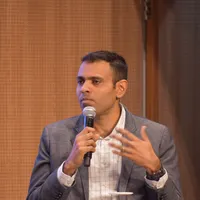
About Vikas K Vijayakumar
Professional summary
Vikas K Vijayakumar is an Enterprise Architect and technology leader with over 20 years of experience helping global organisations design, modernise, and scale complex technology platforms. Throughout his career, he has led architecture across large enterprises, designing systems that operate at global scale and support millions of customers.
Today, he leads enterprise architecture and platform transformation for Shell's global Mobility business, helping shape the technology strategy behind platforms serving more than 8 million customers and processing over 400 million transactions annually across more than 50 countries. His work spans enterprise architecture, cloud strategy, platform engineering, technology governance, and large-scale modernisation, while leading teams of architects and senior technologists responsible for delivering long-term strategic outcomes.
This site is where he shares what he has learned—and continues to learn—about building technology organisations that can thrive in an era increasingly shaped by AI.
Rather than focusing on individual technologies or frameworks, his work explores the bigger questions:
- How should enterprises adopt AI responsibly and at scale?
- What distinguishes good architecture from architecture that creates lasting business value?
- How do platform engineering and cloud operating models accelerate innovation?
- What does effective engineering leadership look like as organisations become increasingly AI-native?
- How should technology strategy evolve as software shifts from systems of record to systems of intelligence?
These questions form the foundation of the six themes explored throughout these insights. He believes architecture is ultimately a business discipline. Great technology is valuable not because it is technically sophisticated, but because it enables organisations to adapt faster, make better decisions, and create sustainable competitive advantage.
The goal of these insights is simple: to publish thoughtful, experience-driven articles that help architects, engineering leaders, and technology executives make better decisions. Whether designing enterprise platforms, leading digital transformation, building AI capabilities, or preparing for executive technology leadership, readers will find practical perspectives grounded in real-world experience rather than theory.
Thank you for visiting.
Leadership philosophy
This publication treats AI adoption, platform investment, architecture decisions, and organizational design as one connected system rather than separate disciplines. Perspectives are direct about trade-offs, clear about uncertainty, and skeptical of technology decisions that cannot be traced to a business outcome.
The voice is analytical and pragmatic rather than promotional: no vendor marketing language, no artificial certainty, and external sources and inspiration are credited rather than presented as original when they are not.
Topics covered by the publication
- AI & Digital Transformation
Applying AI strategically to reshape products, platforms, operating models, and customer experiences.
- Architecture at Scale
Designing resilient, secure, and evolvable systems that operate across global enterprises.
- Platform Engineering
Building internal platforms that enable engineering teams to move faster while improving reliability, governance, and developer experience.
- Enterprise Architecture
Connecting business strategy, capabilities, processes, data, and technology into coherent transformation roadmaps.
- Engineering Leadership
Growing high-performing engineering organizations, developing architects, and creating cultures that balance autonomy with accountability.
- Technology Strategy
Making long-term technology investment decisions that align innovation with measurable business outcomes.
Selected experience themes
Enterprise Generative AI Strategy
Vikas defined and drove the Generative AI strategy for Shell Retail, translating advances in large language models into a structured enterprise adoption roadmap. The work connected high-value use cases and economic potential with investment priorities, operating-model changes, human oversight, safety controls, and phased experimentation—positioning AI as a strategic transformation capability rather than a collection of isolated pilots.
Enterprise AI and Machine Learning Architecture
He developed a Retail-wide AI/ML reference architecture covering traditional machine learning and Generative AI. The architecture defined lifecycle processes, capabilities, governance, MLOps, RAG, agentic AI, knowledge graphs, and decision frameworks for when to consume, embed, extend, fine-tune, or build AI solutions—improving consistency, cost discipline, and responsible adoption.
AI-Assisted Legacy Modernisation
Vikas initiated and shaped a program for applying Generative AI to poorly documented, tightly coupled, and business-critical legacy systems. The initiative combined structural code analysis with LLM-based documentation to improve architectural transparency, identify modernisation pathways, and evaluate AI-assisted modernisation as a repeatable enterprise capability rather than a one-off experiment.
Global Fleet Card Platform Transformation
He led the end-to-end architecture for a multi-year transformation that replaced a supplier-dependent, on-premises fleet card platform with a cloud-native distributed architecture. Domain-driven design, micro services, event-driven integration, elastic scaling, unified observability, and data rationalisation improved resilience and change velocity while shifting the operating model from vendor dependency towards platform ownership.
Common Distributed Platform and Reference Architecture
Vikas defined a common, cloud-agnostic platform for delivering micro services consistently across multiple product teams. Built around Kubernetes, Docker, service mesh, and Azure, the platform abstracted infrastructure and cross-cutting concerns, improved resilience and security, accelerated onboarding, and reduced dependence on individual cloud providers.
API Economy and Ecosystem Enablement
He defined and executed an API strategy that repositioned APIs from technical integration artefacts to strategic digital products. The resulting architecture, governance model, and global API platform enabled integration across more than 20,000 retail sites and 500 B2B partners, accelerating partner onboarding and supporting platform-led ecosystem growth.
Global Salesforce Transformation for Sales and Customer Operations
Vikas led the architecture for a global Salesforce Sales and Service Cloud implementation that modernised the end-to-end customer acquisition and servicing lifecycle. The platform improved lead capture, pipeline visibility, opportunity and deal management, sales-team collaboration, and customer handovers, while giving Sales and Customer Operations teams a unified view of customer interactions.
Global Digital Loyalty Platform
He designed the end-to-end architecture for Shell GO+, a global loyalty platform supporting millions of B2C customers across multiple geographies. The solution integrated thousands of point-of-sale systems and approximately 20 enterprise applications, enabling real-time points processing, consistent customer and product views, multichannel experiences, and personalised rewards powered by an AI-based recommendation engine.
Architecture Capability and Leadership
Vikas scaled a globally distributed Solution and Data Architecture capability from three to 25 architects and principal engineers. Alongside growing the team, he established architecture principles, governance practices, and portfolio knowledge while coaching architects to operate effectively across strategy, delivery, and senior stakeholder engagement—improving architectural consistency and execution quality.
Technology Radar and Portfolio Governance
Vikas established and maintained a portfolio-wide Technology Radar to guide decisions across languages and frameworks, platforms and tools, data management, integration, and engineering techniques. Combined with architecture assurance covering non-functional requirements, technical debt, security, CI/CD maturity, total cost of ownership, and strategic alignment, it provided a consistent framework for making technology choices and reducing fragmentation across the enterprise landscape.
Speaking and collaboration
Open to speaking engagements, podcast conversations, and technical advisory discussions on AI transformation, enterprise architecture, platform engineering, and technology strategy — the topics covered by this publication. Use the contact links below to start a conversation.