AI Won’t Transform Your Business Until You Transform the Business
AI adoption isn't the same as AI transformation. Real change happens only when enterprises redesign decisions and workflows around AI, not just accelerate the same old process.
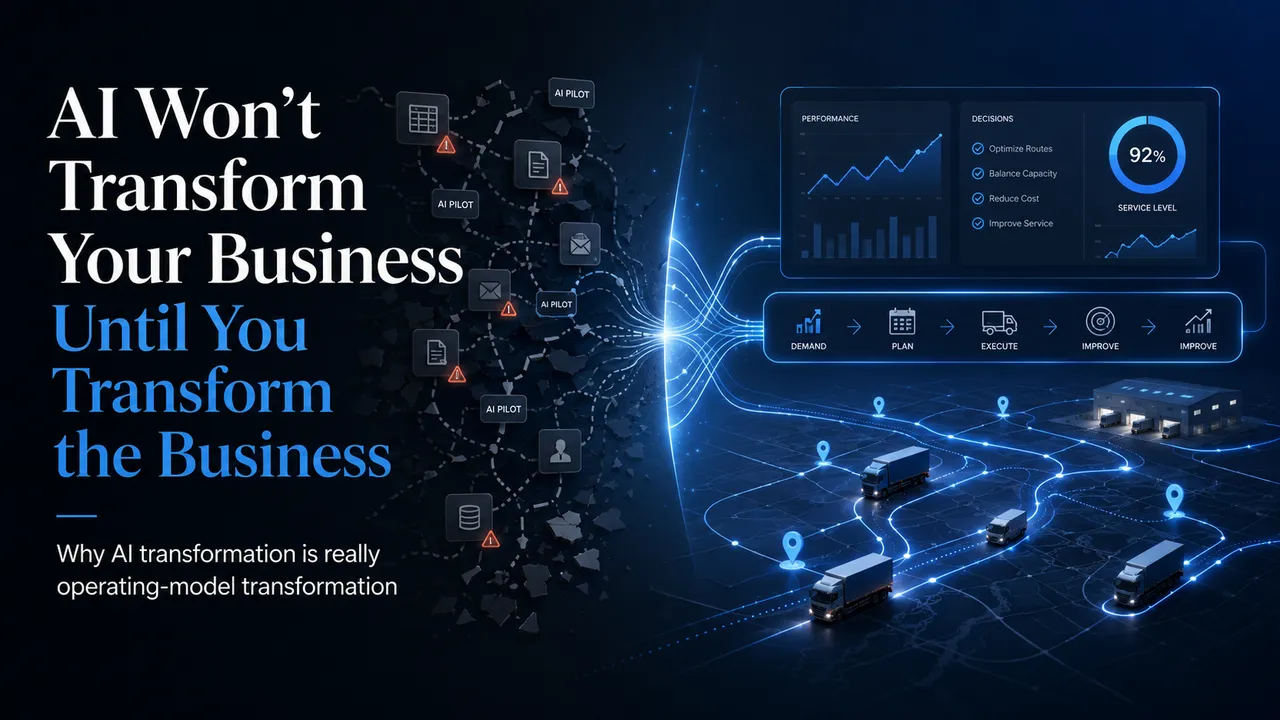
I recently participated in a panel discussion at PES University’s AI Summit 2026 around a deceptively simple question: “AI Transformation Without Process Transformation: Are Companies Scaling Intelligence or Chaos?”
It is a question I have increasingly found myself thinking about as enterprises accelerate their investments in AI. AI adoption is no longer the problem. Organizations are experimenting with copilots, generative AI, agents, predictive models and increasingly sophisticated automation. The harder question is whether any of this is fundamentally changing how the business operates. The evidence suggests there is still a considerable gap. McKinsey’s 2025 State of AI survey found that nearly two-thirds of respondents said their organizations had not yet begun scaling AI across the enterprise. While organizations were reporting benefits at individual use-case level, only 39% reported any enterprise-level EBIT impact from AI—and most of those respondents attributed less than 5% of EBIT to AI use.
That gap matters because most companies do not have an AI innovation problem. They have an AI operating-model problem. Simply adding intelligence to an existing process does not necessarily make the organization intelligent. Sometimes it just allows the organization to execute a bad process faster.
The Productivity Trap
One of the easiest places to see this distinction is marketing. Imagine a marketing organization that previously took several days to create campaign artifacts—email copy, product descriptions, images, presentations and social-media content. With generative AI, much of this work can now be produced in hours, sometimes minutes. That is valuable. The organization may reduce cost, accelerate campaigns and allow employees to spend their time elsewhere. But I would hesitate to call it transformation, because the process fundamentally remains the same. Someone still decides which campaign should be launched, determines the audience, chooses the offer and decides when the campaign should run. AI has accelerated execution, but it has not fundamentally changed decision-making.
I see three broad stages of enterprise AI adoption.
Stage 1: AI as a Tool
Individuals use copilots, assistants and generative AI to perform existing tasks faster.
Stage 2: AI Embedded Into Workflows
Intelligence becomes part of business processes rather than something employees invoke manually. Documents are classified automatically, customer interactions are summarized, anomalies are detected and recommendations appear inside operational systems.
Stage 3: AI Changes the Decision System
This is where transformation begins. Return to the marketing example. Imagine an AI-enabled marketing system continuously analyzing customer behavior, transactions, product usage, engagement patterns and external signals. Rather than waiting for someone to define a quarterly campaign, the system identifies a customer segment with a particular need, determines the appropriate offer, generates the content, selects the channel, decides when to engage and continuously learns from the response. Humans have not simply become faster at running campaigns. The mechanism by which marketing decisions are made has changed. That is transformation.
If AI is saving time, it is productivity. If AI is changing decisions, it is transformation.
There is nothing wrong with productivity; it can create enormous value. The mistake is confusing productivity improvement with business transformation.
Stop Scaling Pilots. Start Scaling Outcomes.
A second pattern I see repeatedly is what I think of as the enterprise AI pilot trap. Most large organizations are not short of AI ideas. Ask employees for potential use cases and within weeks there can be hundreds of them. Innovation teams launch proofs of concept, vendors demonstrate impressive capabilities and teams build prototypes. Many of them work, and yet remarkably few become part of how the enterprise actually operates.
This is not just anecdotal. McKinsey’s 2025 research found that only about one-third of respondents said their organizations had begun scaling AI programs across the enterprise, despite 88% reporting regular AI use in at least one business function.
The graveyard of AI pilots is much bigger than the pipeline to production.
The reason is that proving a model works is only a small part of creating business value. Consider predictive maintenance in fleet management. A data-science team might build a model capable of predicting vehicle failures from telemetry, maintenance history and sensor data. The model demonstrates impressive accuracy, so technically the pilot is successful. But imagine that maintenance teams still work according to predetermined schedules, the fleet-management platform does not consume the predictions, workshop capacity is planned independently, spare parts are ordered using the old process, and drivers and operations managers do not trust or understand the recommendations.
The organization has created intelligence, but it has not changed the operation. The difficult work begins after the model works. How will maintenance schedules change? Which system consumes the recommendation? Who is accountable for acting on it? What happens when the model and an experienced technician disagree? How should inventory planning change? What metrics demonstrate that predictive maintenance has actually reduced downtime or cost? Those are not machine-learning questions. They are architecture, process, governance, organizational-design and leadership questions.
Interestingly, McKinsey found that AI high performers were nearly three times as likely as other organizations to fundamentally redesign individual workflows, and workflow redesign was among the factors most strongly associated with meaningful business impact. This is why I would protect investment in workflow redesign and change management before protecting an unlimited portfolio of experiments. Models will change, and today’s state-of-the-art model will eventually be replaced by another. What is much harder to replace is an organization’s ability to translate intelligence into action.
Before You Automate a Process, Question the Process
There is an idea from Elon Musk that is particularly relevant here. During a 2021 tour of SpaceX’s Starbase with Tim Dodd, Musk described a recurring engineering failure this way:
“The most common error of a smart engineer is to optimize a thing that should not exist.”
It is an engineering principle, but I think it applies equally well to enterprise AI. Organizations frequently start with the question:
“How can AI automate this process?”
A better first question is:
“Why does this process exist in its current form?”
And perhaps an even more important one is:
“If we designed this business today with AI available from the beginning, would we design the process this way at all?”
That question changes the conversation. Instead of taking a twenty-step workflow and asking AI to automate five steps, perhaps the real opportunity is to turn the twenty-step workflow into five. AI transformation should therefore not follow:
Existing process → AI → faster existing process
It should increasingly follow:
Business outcome → decisions required → redesigned workflow → appropriate combination of humans, AI and automation
Technology comes after the operating-model question, not before it.
AI Scales Decisions. That Is Both the Opportunity and the Danger.
Fleet management provides another useful example. Suppose a fleet operates thousands of vehicles. At one level, AI might generate weekly driver-performance reports. Useful, but primarily productivity. At another level, AI might predict vehicle failures. More valuable, but still only a recommendation unless operations change around it. Now imagine a system continuously evaluating traffic, delivery commitments, fuel consumption, driver availability, vehicle condition and customer priorities, and dynamically assigning jobs and rerouting vehicles. The business is no longer simply doing the same work faster. The decision loop itself has changed. Decisions that might once have required multiple people and several hours can potentially happen continuously.
That is enormously powerful, but it leads to a principle that I think deserves much more attention:
AI scales decisions. If your decision-making system is broken, AI can scale the problem as efficiently as it scales the solution.
This is why the largest risk in enterprise AI may not ultimately be a model making a bad recommendation. It may be an organization blindly accepting a recommendation it does not understand. As AI becomes embedded deeper into business processes, architecture therefore needs to include more than models and APIs. We need:
- confidence thresholds
- observability
- traceability
- escalation paths
- clearly defined boundaries between autonomous action and human judgment
- explicit accountability
An AI system can make a recommendation. It cannot assume organizational accountability for the consequences.
Not Every Decision Should Become an AI Decision
The more capable AI becomes, the more important another leadership skill becomes: knowing where not to deploy it. A simple lens I use is to think about repeatability and consequence. High-repeatability, low-consequence decisions are natural candidates for increasing levels of automation. As consequence increases—safety, employment, financial decisions, fundamental rights—the threshold for autonomy should rise.
The EU AI Act provides a useful regulatory expression of this principle. It takes a risk-based approach, prohibiting certain AI practices while imposing additional obligations on systems classified as high risk. Consider recruitment. Under Annex III of the EU AI Act, certain AI systems used for recruitment and candidate selection are classified as high risk because they can materially affect employment opportunities and people’s livelihoods.
In such situations, governance cannot amount to little more than placing a person at the end of the process to click “approve.” The legislation requires high-risk AI systems to provide sufficient transparency for deployers to interpret their outputs and use them appropriately, while its human-oversight provisions require systems to be designed so that natural persons can effectively oversee their operation. For enterprise leaders, this gets to the heart of what we often call explainability. The objective should not simply be that a human technically appears somewhere in the workflow. That person needs enough information, competence and authority to interpret the AI output, recognize its limitations, challenge it where appropriate and intervene when necessary.
A human in the loop who cannot interpret or challenge the AI output is not really exercising oversight. It is governance theatre.
What Does an AI-Transformed Organization Actually Look Like?
This brings me to perhaps the most important question: how do we know when an organization has actually transformed? I would look for five signals.
1. Workflows Have Changed
AI is not sitting beside the existing process as another tool. Parts of the process have disappeared, decision points have moved and work has been redesigned around new capabilities.
2. Decision Latency Has Collapsed
Decisions that previously moved through reports, meetings and organizational layers increasingly happen close to real time.
3. Humans Have Moved Up the Decision Hierarchy
People spend less time collecting information and executing repetitive decisions and more time defining objectives, handling exceptions, exercising judgment and managing ambiguity.
4. Architecture Has Shifted Toward Reusable AI Capabilities
Common data, model access, security, observability, orchestration and governance become platform capabilities rather than being rebuilt for every experiment.
5. The Metrics Have Changed
The organization stops celebrating the number of copilots deployed or proofs of concept completed. Instead it asks:
- Did revenue increase?
- Did downtime fall?
- Did customer experience improve?
- Did decision time decrease?
- Did risk reduce?
- Did we fundamentally improve the economics of the process?
That is the transition from AI adoption to AI transformation.
In February 2026, Demis Hassabis and his Google DeepMind colleagues described their view even more strongly:
“We believe AI will be the most transformative technology in human history.”
I believe that potential is real. But enterprises will not capture it simply by giving everyone access to increasingly powerful models.
The Questions Leaders Should Be Asking
When I discuss AI initiatives, I increasingly think leaders should ask five questions before asking which model to deploy:
- Which business decision are we trying to improve?
- What would we redesign if the current process did not already exist?
- Which parts should AI automate, which should it augment, and which should remain human?
- Who owns the outcome when AI participates in the decision?
- Which business metric will prove that anything actually changed?
For architects and engineers, this means expanding our definition of architecture. AI architecture cannot only be about model selection, RAG patterns, agents, vector databases and inference platforms. We also have to understand the decision architecture of the enterprise. For business leaders, the implication runs in the opposite direction. AI can no longer be delegated entirely to technology teams. If AI changes who makes decisions, how quickly decisions happen, what information is required and which roles exist, then AI strategy is business strategy.
That is why I increasingly believe that:
AI transformation is operating-model transformation.
The organizations that win will not necessarily be those with access to the best models. Increasingly, the same frontier capabilities will be available to competitors. The advantage will come from what organizations build around those models: proprietary context, architecture, redesigned workflows, governance, trust and, most importantly, the ability to turn intelligence into action.
The Simplest Test of Transformation
Perhaps that is the simplest test of transformation. If AI disappeared tomorrow and employees simply returned to doing exactly the same work a little more slowly, the organization had achieved productivity improvement. If removing AI materially changed how the business could operate, make decisions and compete, something deeper had happened.
That is transformation.
And before enterprises rush to scale intelligence, they need to make sure they are not simply scaling chaos.
References & Further Reading
- The state of AI in 2025: Agents, innovation, and transformationSource
McKinsey & Company · Alex Singla, Alexander Sukharevsky, Bryce Hall, Lareina Yee, and Michael Chui · November 5, 2025
Accessed August 12, 2026
Cited for enterprise AI scaling, EBIT impact, workflow redesign, and characteristics of AI high performers.
- Starbase Tour with Everyday Astronaut — Part 1Source
Everyday Astronaut / Elon Musk Archive · Tim Dodd and Elon Musk · July 30, 2021
Accessed August 12, 2026
Source for Elon Musk's engineering principle about avoiding optimization of things or processes that should not exist.
- Regulation (EU) 2024/1689 — Artificial Intelligence ActSource
Official Journal of the European Union · European Parliament and Council of the European Union · July 12, 2024
Accessed August 12, 2026
Cited for the EU AI Act's risk-based framework, classification of employment-related AI as high risk, transparency requirements, and human-oversight obligations.
- Accelerating discovery in India through AI-powered science and educationSource
Google · Demis Hassabis, Lila Ibrahim, and Pushmeet Kohli · February 18, 2026
Accessed August 12, 2026
Source for Google DeepMind's characterization of AI as potentially the most transformative technology in human history.
- AI Beyond the Buzzword — Real Business TransformationInspiration
PES University
Accessed August 12, 2026
The PES University AI Summit 2026 and its panel discussion on AI transformation provided the original inspiration for this article.
- Are your people ready for AI at scale?Further reading
McKinsey & Company · March 2, 2026
Accessed August 12, 2026
Recommended follow-up on organizational change, workforce readiness, and redesigning work around AI.
- Building the foundations for agentic AI at scaleFurther reading
McKinsey & Company · Asin Tavakoli, Brian Goodman, Henning Soller, and Kayvaun Rowshankish · April 2, 2026
Accessed August 12, 2026
Recommended follow-up on data architecture, workflows, platforms, and operating-model foundations for scaling agentic AI.